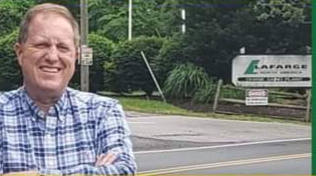
The following article was submitted by Fifth Councilman David Marks and his plan to limit development at the old Lafarge Quarry in Middle River with green uses
In 2023, I lead the Baltimore County Council in killing the Lafarge Planned Unit Development.
My predecessor had advanced this warehouse project despite no guarantee that appropriate infrastructure, mainly a new connection to MD 43, would be in place before the development opened. I did not support moving forward without that guarantee.
In 2024, I introduced the concept of the Eco Park, the first of its kind in Baltimore County. This plan puts 60 percent of the property permanently into green uses, allows for 40 percent commercial use.
Right now, I have a bill before the County Council clarifying a prerequisite that a new road connection to MD 43 must be completed before any building is finished.
The original Planned Unit Development comments proposed a widening of Ebenezer Road. I specifically placed language in the Baltimore County Master Plan stating that there would be no widening of Ebenezer Road.
Recent comments from county departments have falsely referenced Ebenezer Road improvements; those are incorrect. County funding will not be used to widen Ebenezer Road.
We now have a choice.
Governor Wes Moore wants to pass legislation that usurps the ability of local governments to block dense development. He’s pushed it year after year.
His Secretary of Planning has inserted himself into Baltimore County debates as we considered ways to eliminate school overcrowding.
House Bill 239 prohibits counties from adopting regulations that limit housing in certain zones. Despite opposition from our state legislators to this type of legislation, the Governor’s allies are licking their chops at this bill passing.
Imagine hundreds of homes being built on Earls Road. It’s a real possibility if we fail to finalize a different vision for that area.
The alternative is to be proactive, set strong infrastructure requirements, and consider a proposal that blocks harmful development on most of the Lafarge Quarry.
Under the plan submitted to Baltimore County, only 40 percent of the property would be used for commercial development.
The other 60 percent, more than 250 acres, would be permanently dedicated to green uses.
Those green components include:
• A 40 acre wetland bank, which would be the largest in the entire watershed covering Baltimore, Harford, and Anne Arundel Counties;
• A 60 acre energy project that participates in the Community Solar program, potentially providing between 10 to 20 percent on discounts to many Middle River residents when they pay their BGE bills;
• A 70 acre forest bank, three times larger than any other forest bank in Baltimore County;
• An additional 80 acres of existing forest and wetlands placed into permanent conservation, protecting land that could otherwise be mined or developed.
• Walking trails throughout the green space areas.
All buildings on the site would be required to meet LEED green energy standards, with provisions for rooftop solar. Even within the commercial portion, the plan requires forest conservation buffers along Earls Road.
Most importantly, I have already submitted legislation before the County Council that requires infrastructure improvements, such as widening Bengies Road past Crossroads Circle and creating a new MD 43 access at Pocomoke Court and Tangier Drive, near the 7-11, designed to keep heavy truck traffic off local roads.
This plan would turn existing industrial land into a balanced project that protects the environment while improving traffic flow.
Almost no one wants new development. I’ve downzoned thousands of acres throughout eastern Baltimore County and advanced more than a dozen new parks, at the former C.P. Crane property.
It’s unrealistic, however, to think that the hundreds of privately-owned acres at the Lafarge Quarry will remain undeveloped forever.
I believe a plan that forces 60 percent to be used for green purposes, with new infrastructure requirements, beats the alternative advanced by those who want dense housing development.